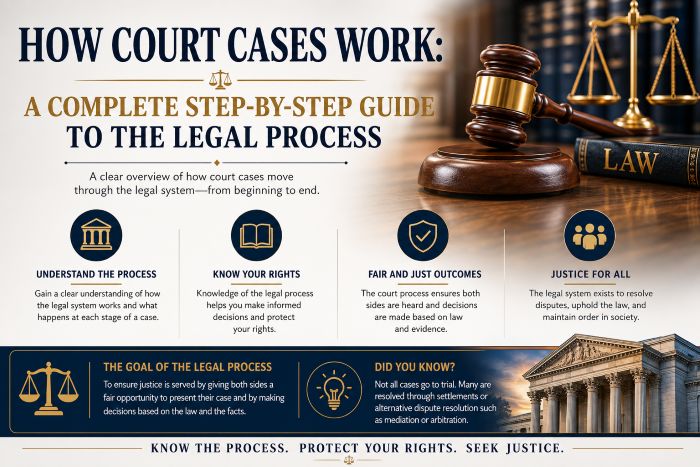
Whether you are in a fight called to serve on a jury or just want to know how the court system works learning about the court process can help make a complicated topic much easier to understand. Court cases follow a path meant to make sure everything is fair protect legal rights and let both sides share their side of the story before a fair judge or jury. Even though movies show courtroom fights that end in a few hours real legal cases often have many steps that can take weeks, months or even years to finish.
Every court case starts with a problem or a possible rule that was broken. From there the legal system goes through a number of organized steps that include starting the case telling the people involved collecting proof holding meetings and finally making a decision. Each step has a role and helps make sure that decisions are based on facts, proof and the right laws instead of guesses or feelings.
What Is a Court Case?
A court case is a legal problem taken to court to fix disagreements make sure laws are followed or decide if someone did a crime. Courts exist to offer a place where proof can be checked people can give their stories and legal arguments can be judged by the rules that are in place. Everyone involved including judges, lawyers, jurors, people who start the case people who are accused and witnesses has a job to make sure the legal process is fair and clear.
There are two types of court cases: civil and criminal. Civil cases deal with problems between people, companies or groups. Examples are disagreements about contracts, problems with property injuries from accidents and family issues. Criminal cases involve actions that harm society, such as stealing, hurting someone lying to get money or killing. In cases the government takes the case against the person accused and if found guilty the person might face fines being watched closely or going to jail.
Knowing what type of case it is matters because the steps what needs to be proven and what could happen are very different between criminal courts.
Step 1 – Starting the Case
Every legal case starts when someone officially puts the case into the system. In a case the person who starts the case called the plaintiff fills out a paper that explains the problem says why the other person is responsible and asks for something like money or a rule to stop something. They usually have to pay a fee. Some people might not have to if they can’t afford it.
In a case the people who bring the case called prosecutors look at the proof collected by the police before deciding if they should take the case to court. Once there is proof the charges are written down and sent to the court and the criminal case officially starts.
After the case starts, the person being accused must be told about it through a process called service of process. This makes sure that everyone knows about the case and has a chance to respond. Making sure the person is properly told is one of the important rights in the legal system. Without this courts can’t move forward because every person has a right to know and defend themselves against the case.
Step 2 – First Court Meeting
After the case starts the court sets a meeting. In cases this meeting is called an arraignment. During the arraignment the judge tells the person accused of the crime the defendant, what the charges are explains legal rights and asks if they want to say guilty not guilty or no contest if allowed. The court might also think about bail depending on how serious the crime’s whether the person might run away or be a danger.
Civil cases usually start with a meeting called a scheduling conference or a first hearing. During this meeting the judge looks at how the case should move makes sure all the papers were given to the right people sets deadlines and talks about how the case will go. Both sides can also bring up legal problems that need to be solved before trial.
These early meetings usually don’t decide the case. They set up the plan for everything else. Deadlines for giving proof filling out papers and setting a trial date are usually set during this time.
Step 3 – Getting the Facts
Discovery is one of the important parts of any court case because it lets both sides get and share information before the trial. Of surprising each other in court the legal system wants both sides to know what the other side has. This helps each side understand the strengths and weaknesses of the side.
During discovery lawyers ask for papers send questions to each other look at items get digital records and talk to witnesses. They also do depositions. During a deposition a witness answers questions under oath outside of court while a person writes down everything. These recorded answers can be used later in trial if a witness changes their story or can’t be there.
Expert witnesses often help during discovery too. Doctors, engineers, money experts, crime experts and others prepare reports that explain proof that jurors might not understand. By the end of discovery both sides usually have a better idea of what the facts and issues are.
Step 4 – Getting Ready for Trial
Before the trial starts lawyers can ask the judge to make decisions on some issues. These requests are called -trial motions. They can ask the judge to drop some parts of the case stop some proof from being used make the other side give proof or even ask the court to decide the case without a trial if there is no real disagreement.
Judges look at these requests carefully because solving these issues before trial can save time and money. Sometimes a successful motion can change the case a lot. End it completely.
Step 5 – Settling the Case
Many court cases never go to trial. In cases the parties often agree on a solution without going to trial. This is called a settlement. Settlements help save money avoid uncertainty and let both sides skip court fights.
In cases the person accused often agrees to a deal called a plea bargain. In a plea deal the person agrees to say guilty to some charges in exchange for punishments or having other charges dropped. Judges check these deals to make sure they are fair and allowed by the law before saying yes.
Step 6 – Going to Trial
If no deal is made the case goes to trial. The trial starts with picking a jury if needed. Lawyers ask possible jurors questions to make sure they can be fair and not biased during the trial.
Once the jury is picked both sides give opening talks about their side. The person who started the case or the prosecutor presents their proof first by calling witnesses showing papers, pictures, videos and experts. The other side then asks questions to check if the witness is telling the truth or is clear.
After both sides finish their proof the lawyers give talks explaining why the judge or jury should decide in their favor. The judge then tells the jury what the law says before they start talking in private.
Step 7 – Deciding the Case
After they talk the jury gives their decision. The judge decides if there is no jury. In cases the decision says if the person is guilty or not guilty. If they are guilty they go to another meeting where the judge decides the punishment looking at records how bad the crime was and any reasons that might make the punishment less.
In cases the decision might mean one side has to give money transfer something follow a contract or do what the court says. Once the decision is made it can be used to force the side to do what the court decided unless it is changed later.
Step 8 – Appeal
The legal process doesn’t always end after the decision. If someone thinks the court made a mistake they can ask for a review. Appellate courts don’t hear witnesses or look at new proof. They check the papers from the trial to see if the law was used correctly and if mistakes changed the result.
Appellate courts can decide to say the first decision was right change it order a trial or change parts of the decision. Appeals are important because they help keep the system fair and the same for everyone.
Conclusion
Learning how court cases work makes the legal system much easier to understand. Every part, from starting the case to the chance, for an appeal has a job to protect peoples rights and make sure justice is given fairly. Even though the exact steps can change based on where the case’s the type of case the overall process stays the same: start the case tell the other side get proof fix early problems go to trial if needed make a decision and give a chance to check the decision again.
Whether you are dealing with a problem studying law or just want to know more understanding these steps helps you see how courts fix problems and keep the rules of the country working.
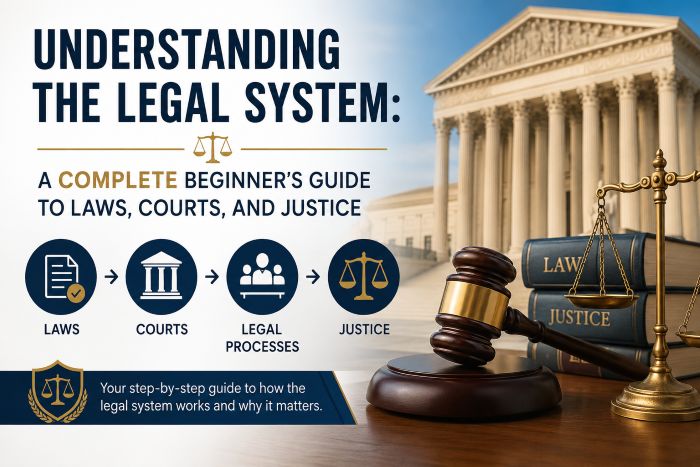
You Can Also Read : Understanding the Legal System: A Complete Beginner’s Guide to Laws, Courts, and Justice