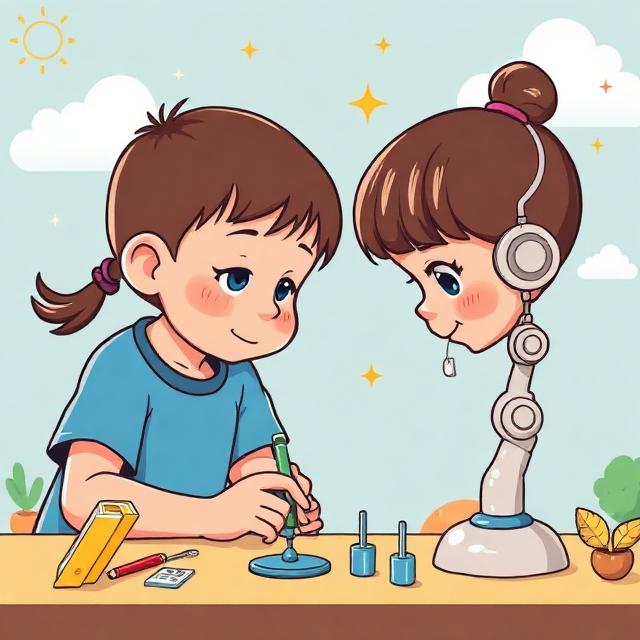
Artificial intelligence is no longer something children will encounter only in the future. It is already part of everyday life—from educational apps and search engines to chatbots, games, recommendation systems, and creative tools. For parents, this brings an important question: How can we help children enjoy the benefits of AI without exposing them to unnecessary risks?
The goal is not to keep children completely away from technology. Instead, parents can teach them how to use it thoughtfully, safely, and responsibly.
This is where AI for kids becomes more than just a learning trend. It is about developing digital awareness, critical thinking, privacy habits, and the confidence to ask for help when something online feels wrong.
UNICEF recommends that children develop AI literacy so they can understand how AI works, recognize inaccurate information, protect their privacy, and seek support when something concerns them.
Why Children Need Guidance When Using AI
Children are naturally curious. If an AI tool can answer a question in seconds, create a picture, explain homework, or tell a story, they are likely to experiment with it.
The problem is that children may not always understand the limitations of AI.
An AI system can provide an answer that sounds confident but is incorrect. It may also produce inappropriate content, encourage unhealthy dependence, or collect information that a child should never share.
Recent research from UNICEF found that AI use among children is already widespread, with many children using AI for homework and some turning to it for personal advice.
That is why simply saying, “Don’t use AI,” may not be enough. Children need practical rules they can actually understand and follow.
1. Explain What AI Is in Simple Language
Parents do not need to be AI experts to have a useful conversation with their children.
Start with simple examples. You can explain that AI is technology designed to recognize patterns, process information, and generate responses. It can be helpful, but it does not understand the world or experience emotions in exactly the same way people do.
For younger children, you might say:
“AI is a computer tool that can help us with certain tasks, but it can also make mistakes.”
That one sentence teaches an important lesson: AI is a tool, not an all-knowing person.
UNICEF recommends introducing AI conversations early and using familiar examples that children can relate to.
2. Teach Children Never to Share Private Information
One of the most important lessons in AI for kids is privacy.
Children should understand that they should not enter sensitive personal information into an AI tool unless a trusted adult has checked that it is appropriate.
Teach them not to share things such as:
- Home address
- Phone number
- Passwords
- School identification details
- Financial information
- Private photographs
- Family information
- Personal conversations
- Other people’s private information
Privacy can be a difficult concept for children because they may not realize that seemingly harmless details can reveal a lot about them.
Make the rule simple: If you would not tell a stranger online, don’t type it into an AI tool without asking a trusted adult.
UNICEF highlights children’s data and privacy as key elements of child-centred AI.
3. Teach Kids That AI Can Make Mistakes
One of the biggest mistakes children can make is assuming that an AI answer must be correct because it sounds convincing.
Parents can turn this into a fun learning exercise.
Ask your child to find the answer to a simple question using AI. Then check it together using a trusted book, teacher, educational website, or other reliable source.
You can say:
“AI gave us an answer. Now let’s become detectives and see whether it is actually correct.”
This approach makes fact-checking feel less like a warning and more like a skill.
Children should learn that AI can sometimes generate inaccurate, incomplete, or biased information. UNICEF also highlights the importance of helping children recognize AI errors and think critically about AI-generated content.
4. Encourage AI as a Learning Assistant—Not a Homework Machine
AI can be incredibly useful for education. It can explain difficult concepts, suggest examples, help children brainstorm ideas, and provide practice questions.
But there is a difference between using AI to learn and using AI to avoid learning.
Instead of asking AI to complete an entire assignment, encourage children to ask questions such as:
- “Can you explain this in simpler words?”
- “Give me three practice questions.”
- “Can you show me where my reasoning went wrong?”
- “Help me brainstorm ideas.”
The child should still do the thinking.
UNICEF notes that excessive reliance on AI can lead children to offload learning responsibilities and may reduce opportunities for independent problem-solving.
5. Set Age-Appropriate Boundaries
Not every AI tool is suitable for every child.
Parents should check the age requirements, privacy policies, safety features, and intended audience before allowing children to use a particular AI service.
For younger children, using AI together with a parent or caregiver may be more appropriate than independent use. Current guidance from Common Sense Media, for example, recommends avoiding AI chatbots for very young children and using limited, supervised access for children ages 6–12.
The right approach will depend on the child’s age, maturity, and the particular tool.
6. Talk About AI-Generated Images and Videos
Children also need to understand that not everything they see online is real.
AI can now create remarkably realistic images, videos, voices, and other content. A picture that looks genuine may have been generated or altered.
Teach children to pause before believing or sharing surprising content.
Ask:
“Where did this come from?”
“Can we verify it somewhere else?”
“Does this look or sound realistic, or could it have been changed?”
This kind of media literacy can help children become more thoughtful digital citizens.
7. Tell Children They Can Always Come to You
Perhaps the most important safety rule is also the simplest: Don’t make children afraid to tell you when something goes wrong.
If a child sees disturbing content, receives a strange AI-generated message, accidentally shares private information, or becomes uncomfortable with an AI interaction, they should know they can tell a parent without immediately being punished.
A calm response creates trust.
UNICEF emphasizes that open conversations and supportive parenting can help children discuss their experiences with AI instead of hiding them.
8. Create Family Rules for AI Use
Instead of making dozens of complicated restrictions, create a few clear family rules.
For example:
- We don’t share private information with AI.
- We check important AI answers.
- We don’t use AI to cheat at school.
- We don’t create or share harmful content.
- We ask an adult if something feels confusing or unsafe.
- AI does not replace real conversations with family, friends, or teachers.
Writing these rules together can make children feel involved rather than controlled.
9. Explore Safe AI Learning Tools Together
Parents can also introduce children to age-appropriate educational resources designed around learning and creativity.
For families interested in exploring AI in a child-friendly way, KidzoAI can be a useful starting point for discovering AI-focused learning experiences for children.
The best learning environment is one where children can experiment while parents remain involved and available to guide them.
10. Be a Role Model
Children notice what adults do.
If parents constantly accept online information without checking it, share private information casually, or spend hours relying on technology, children are likely to copy those habits.
You don’t need to demonstrate perfect digital behavior. Instead, show your child what responsible technology use looks like.
If an AI gives you an answer, say aloud:
“I’m going to check that before I believe it.”
If an app asks for unnecessary information, explain:
“I don’t think this app needs to know that, so I’m not going to share it.”
Small moments like these can teach powerful lessons.
The Goal Is Safe and Smart AI Use
Teaching AI for kids should not be about creating fear around artificial intelligence. It should be about helping children become confident, curious, and responsible users.
AI can support creativity and learning, but children still need human guidance, real-world experiences, teachers, friends, and family. UNICEF’s current guidance stresses that children’s well-being, privacy, safety, development, and best interests should remain central when AI is used around them.
Parents do not need to know every new AI feature or understand every technical detail. What matters most is keeping the conversation open.
Ask your child what AI they use. Try a tool together. Question its answers. Talk about privacy. Set reasonable boundaries. And most importantly, let your child know that whenever something online feels confusing or uncomfortable, they can come to you.
That combination of curiosity, supervision, and trust is one of the strongest ways to help children navigate an AI-powered world safely.
FAQs About AI for Kids
1. Is AI safe for children?
AI can be useful for children when age-appropriate tools are used with suitable safeguards and guidance. Parents should consider the child’s age, the tool’s policies, privacy practices, and the type of content it can generate.
2. What should children never share with AI?
Children should avoid sharing passwords, home addresses, phone numbers, financial information, private photographs, school identification details, and other sensitive personal information.
3. Can children use AI for homework?
Yes, AI can support learning when used appropriately. Children should use it to understand concepts, practice skills, brainstorm, or receive explanations rather than simply copying AI-generated answers.
4. How can parents teach children to recognize AI mistakes?
Encourage children to verify important information using trusted sources. Make fact-checking a normal part of using AI rather than treating every AI response as automatically correct.
5. At what age should children start learning about AI?
There is no single age for every child. Children can start learning basic ideas about AI quite young, using simple, age-appropriate examples. Independent use of AI tools should depend on the child’s maturity, the specific tool, and appropriate parental supervision.